
July 8, 2026
How Is "AI Plus" Faking It Till They Make It, While Soiling the Name of Make in India with Recycled Chinese Tech?
My notes on what the controversy suggests about Make in India, tech sovereignty, and the messy reality of electronics supply chains.
I came across the AI Plus smartphone controversy while trying to understand what “Make in India” really means in consumer tech.
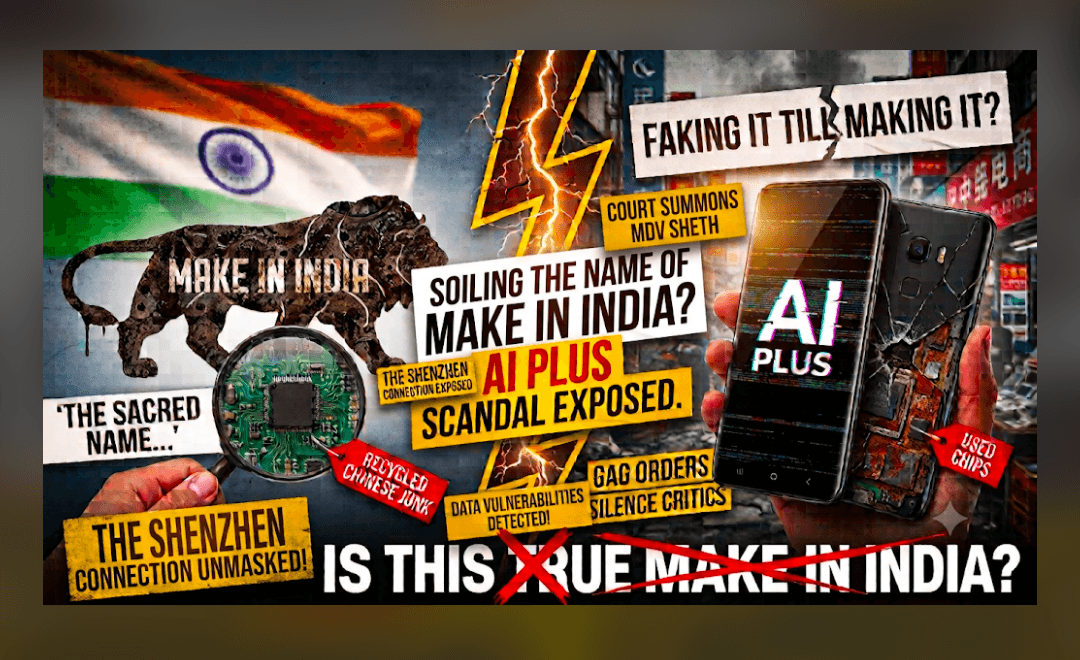
On the surface, the story is about one smartphone brand and a set of serious allegations. But the more interesting part, at least for me, is what it reveals about the gap between patriotic marketing and the actual structure of electronics manufacturing.
These are my notes from the report and the related video material. I’m treating this as a learning exercise, not as a final legal judgment.
The basic controversy
According to the report, AI Plus was launched in July 2025 as a domestic Indian consumer electronics brand led by Madhav Sheth. The brand positioned itself very aggressively around ideas like:
- Indian technology sovereignty
- Data staying inside India
- Software being built in India
- Devices being secure enough for government use
- A contrast against Chinese smartphone brands
This positioning matters because India’s smartphone market is huge, with hundreds of millions of users, and Chinese brands such as Xiaomi, Vivo, and Oppo have historically held a large share of it.
So AI Plus was not just selling phones. It was selling trust, nationalism, and security.
That is why the investigation became such a big deal.
The marketing claims that stood out to me
The report highlights three major claims around the AI Plus phones.
1. “Your data stays safe in India”
The boot screen reportedly promised that user data would remain safe in India, with telemetry localized through Google Cloud India regions.
This is a powerful claim because data localization and digital sovereignty are emotional and political issues, not just technical ones.
2. Indigenous software
AI Plus marketed its phone software, Next Quantum OS, as an Indian software layer. The CEO is quoted in the report as saying that “Made in India means little if software and updates come from abroad.”
That is a strong statement. It also creates a high bar: if a company criticizes others for depending on foreign software, then its own software stack has to be very clean.
3. National security positioning
The brand also claimed that its phones were “certified for government use.” Again, this places the product in a security-sensitive category rather than just the budget smartphone market.
What the investigation claimed to find
The most important part of the report is the technical investigation. The claims are serious, and they mostly fall into two categories: software/firmware and hardware/supply chain.
Software and firmware concerns
The report says independent software analysts decompiled pre-installed system apps and found signs that the AI Plus software was not as indigenous as advertised.
The key claims were:
- Next Quantum OS resembled Realme’s OS very closely, both visually and structurally.
- Several system utilities, including Clean Assistant, Phone Clone, and Mobile Butler / Phone Manager, were allegedly authored by Sprocom Technologies, an ODM based in Shenzhen, China.
- These apps were described as difficult or impossible for users to uninstall.
- Privacy-policy text inside some apps reportedly said user information could be collected directly, automatically, and from “other sources,” with Chinese entities involved in service provision.
- On higher-end devices such as the Nova Flip, decompiled system images allegedly showed ZTE identifiers inside services such as the compass app, fingerprint biometric framework, and AI engine.
- Some of these services allegedly had deep system-level permissions.
The big lesson for me here is that a phone’s nationality is not determined by the logo on the back. The real questions are deeper:
- Who designed the firmware?
- Who controls the system apps?
- Where does telemetry go?
- Who maintains security updates?
- What permissions do pre-installed apps have?
A smartphone is not just hardware. It is a bundle of chips, firmware, system apps, cloud services, update pipelines, permissions, and legal agreements.
Hardware and ODM dependency
The report also argues that AI Plus was not operating like a deep hardware company designing its own devices from the ground up.
Instead, it says AI Plus relied on an ODM model.
My simplified understanding:
- A company using a deeper manufacturing model designs more of the product itself, including hardware layouts, software integration, and supply chain decisions.
- A company using an ODM model may buy an existing reference design, modify the outer shell, add branding, and sell it as its own product.
The report claims AI Plus sourced off-the-shelf designs from lower-tier Chinese ODMs such as Sprocom and Lee Fine Technology, then applied cosmetic changes and branding.
That does not automatically mean a product is bad. ODM manufacturing is common in electronics. But it becomes a problem if the product is marketed as fully sovereign, deeply engineered, or strategically independent.
The secondhand component allegation
One especially concerning part of the report involves memory chips.
The report claims that some low-tier ODMs reduce costs by sourcing recycled or secondhand components from decommissioned electronics. As an example, it compares:
- New 64 GB flash storage module: around
$60 - Used harvested module: around
$20
If true, this creates several risks:
- Harder quality control
- Unknown component history
- More failures in the field
- Difficulty tracing batches
- Problems delivering reliable software updates
The report connects this to customers allegedly being stuck on outdated December 2025 firmware builds, without security updates.
That part made me think about how invisible the supply chain is to normal buyers. Most of us judge a phone by price, specs, camera samples, and maybe update promises. We rarely know whether the components inside are new, traceable, or supported long-term.
The Wearbuds cloning claim
The report also mentions AI Plus Wearbuds, described as a smartwatch with integrated wireless earphones.
According to the investigation, the product marketed as “designed and patented in India” was allegedly a clone of an earlier product by a Chinese company named AI Power. The report even says the logo graphics were closely connected.
Again, the important issue is not just cloning. It is the gap between the marketing claim and the product reality.
The legal response: gag orders and creator takedowns
The legal part of the controversy is what made the story feel bigger than a normal tech review dispute.
According to the report, after Indian tech creators and journalists published videos showing alleged backdoors, missing updates, and cloned hardware, AI Plus responded through legal action rather than a detailed technical rebuttal.
The report says AI Plus obtained an ex-parte injunction from the Delhi High Court.
My understanding of an ex-parte order is simple: one side is heard by the court before the other side has a chance to respond. These orders can be necessary in urgent cases, but they can also create a major imbalance if used aggressively.
The report highlights two tactics:
1. Use of a “John Doe” / “Ashok Kumar” defendant
The company allegedly used an unnamed “John Doe” defendant, which can allow action against unknown parties. The concern raised in the report is that this helped bypass normal notice requirements for specific creators.
2. Notices allegedly sent to wrong emails
For named creators, the report claims legal notices were sent to fabricated or non-existent email addresses, even though the company had previously communicated with them through real press emails.
The result, according to the report, was that multiple critical videos were geoblocked or removed during an important product launch window.
This is the part that worries me most. If consumer tech reporting can be suppressed before creators get a fair chance to respond, then buyers lose access to exactly the kind of information they need before purchasing.
The bigger Make in India question
This controversy made me rethink the phrase “Make in India.”
There are different levels of “made”:
- Assembled in India
- Packaged in India
- Branded by an Indian company
- Designed in India
- Firmware written and audited in India
- Components sourced through a transparent supply chain
- Security updates controlled and delivered by an accountable domestic team
- Core IP owned domestically
Those are not the same thing.
The report argues that India’s current electronics ecosystem often depends on phased manufacturing and local assembly incentives. That can be useful as a starting point. But it does not automatically create true technological sovereignty if the important layers still come from outside:
- PCB designs
- Firmware
- Kernel-level services
- System apps
- ODM reference designs
- Component sourcing
- Update infrastructure
The line from the report that stayed with me is this idea: Make in India cannot just be a cosmetic layer over unvetted foreign-designed blueprints.
That feels like the core lesson.
My takeaway
I don’t think the answer is to reject every product that uses Chinese manufacturing or ODM supply chains. That would be unrealistic. Modern electronics are globally interconnected.
But I do think companies should be honest about what they are actually doing.
If a phone is assembled in India using a Chinese ODM design, say that. If the software is based on an existing foreign stack, say that. If system apps are maintained by third-party vendors, disclose that clearly. If data passes through non-Indian services, do not claim full data sovereignty.
National pride can be a good motivator for building better technology. But if it becomes a marketing shield against scrutiny, it can damage the very ecosystem it claims to support.
For me, this controversy is less about one brand and more about the need for better definitions, better audits, and more respect for independent reviewers.
Questions I’m left with
- What should legally count as “Made in India” for smartphones?
- Should brands be required to disclose ODM partners?
- Should pre-installed system apps have public security audits?
- Should update commitments be legally enforceable?
- How can courts balance brand reputation claims against consumer-interest reporting?
- Can India move from assembly-led manufacturing to deeper electronics design and firmware ownership?
I don’t have clean answers yet. But this case made the questions feel much more urgent.